
How to Search Sequoyah County Traffic Court Records
Most Sequoyah County traffic cases filed at the county level are public and searchable online. Two free systems carry them. On Demand Court Records, known as ODCR, lists Sequoyah among its courts and returns full dockets at no charge. The Oklahoma State Courts Network, or OSCN, offers a second search of the same Sequoyah County District Court files. Both show traffic tickets, declined traffic tickets, and any event charged as a misdemeanor or felony. A citation handled by the Sallisaw Municipal Court will not appear in either one, and that distinction matters before you start typing.
Gather a few details first. A citation number pulls the fastest match, but a driver name works when the ticket is not in hand. ODCR accepts names in Last, First format and lets you narrow by case type or a filed date range. OSCN splits the name into first, middle, and last boxes and adds date-of-birth filters that help when a name is common.
- Open ODCR and choose Sequoyah from the court list.
- Enter the citation or case number, or type the driver name in Last, First format.
- Limit the results by the traffic case type or a filed date range when a name returns many hits.
- Open the matching case to read its charge, court date, plea, and disposition.
- If the file is missing, repeat the search on OSCN or call the Court Clerk's traffic desk.
Which Courts Handle Traffic Cases in Sequoyah County
Traffic venue in Sequoyah County splits cleanly between two levels. The Sequoyah County District Court, through the Court Clerk, holds state and county traffic charges. Those carry the TR and TRC case prefixes and show up in ODCR and OSCN. The Sallisaw Municipal Court handles citations written under city ordinances inside the city limits, and those files sit with the municipal clerk rather than the county system.
The split decides where you search and where you pay. A state trooper or sheriff's citation usually becomes a district case at the courthouse. A city officer's ordinance ticket usually becomes a municipal matter. When you are unsure, the issuing agency printed on the citation is the clearest clue.
| Court | Traffic Cases Handled | Address |
|---|---|---|
| Sequoyah County District Court (Court Clerk) | State and county traffic charges, declined traffic tickets, criminal traffic offenses | 120 E. Chickasaw Ave., Suite 205, Sallisaw, OK 74955 |
| Sallisaw Municipal Court | City ordinance traffic citations within Sallisaw | Court at 113 N. Elm St.; clerk at 115 E. Choctaw, Sallisaw, OK 74955 |
The Sallisaw Municipal Court page lists court dates and the clerk contact a driver needs for a city ticket. The City of Sallisaw Municipal Court page gives the schedule, clerk office, and payment instructions.
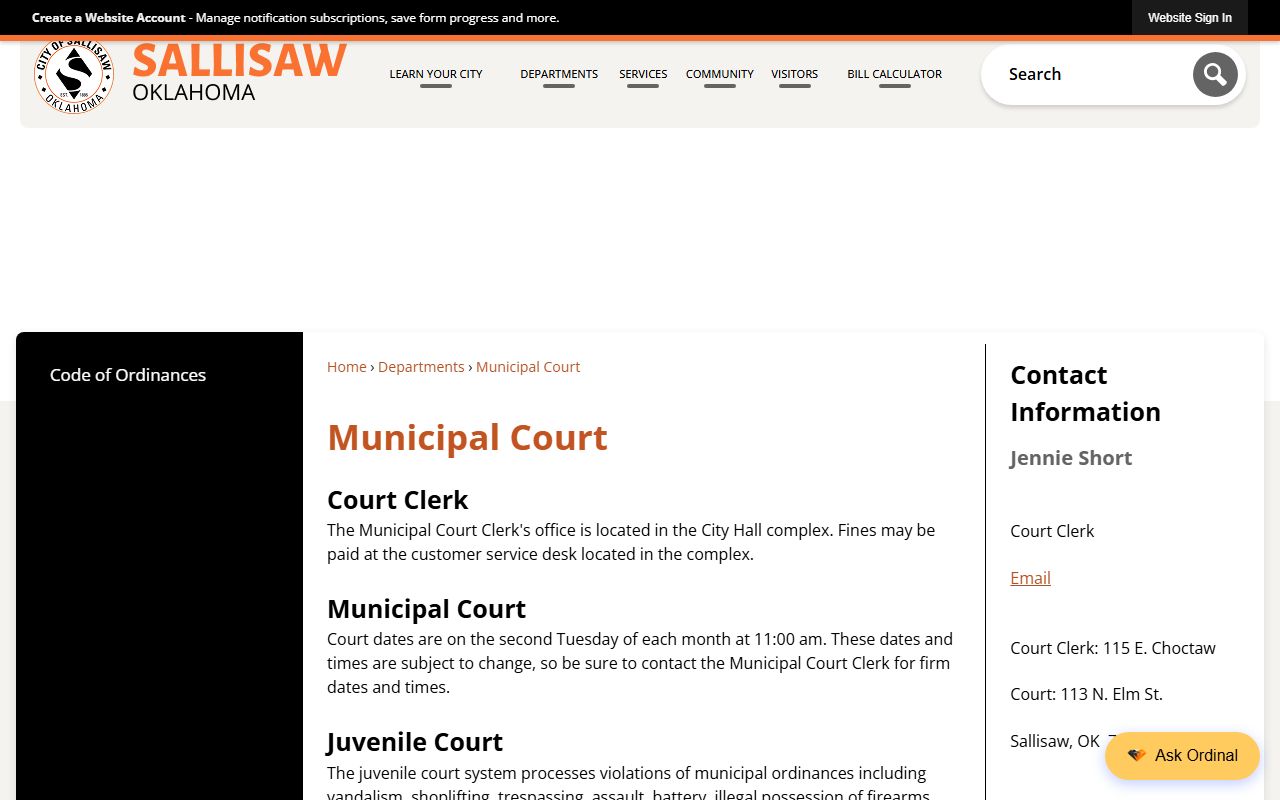
Municipal court meets the second Tuesday of each month at 11:00 am, subject to change, so a city ticket follows a different calendar than a district case. Fines for those citations are paid at the customer service desk in City Hall or online through Xpress Bill Pay, and the municipal clerk can be reached at 918-775-6241.
Note: A district traffic case and a Sallisaw municipal citation never share a docket, so always confirm the issuing court before you search or pay.
Types of Sequoyah County Traffic Cases
Traffic filings cover far more than speeding. The case-type lists in ODCR and OSCN sort them into several groups, and the label on a case tells you how serious the court treats it. Some are simple fine-only tickets. Others ride alongside criminal charges and follow the criminal track instead of the traffic one.
- Moving violations - speeding, failure to obey signals, and similar driving offenses make up the bulk of traffic tickets.
- Equipment and non-moving violations - defects, registration, and insurance citations that do not involve driving conduct.
- Commercial vehicle citations - tickets tied to commercial trucks and CDL drivers, which carry added reporting consequences.
- Declined traffic tickets - citations the prosecutor chose not to pursue, listed as a separate ODCR and OSCN category.
- Criminal traffic offenses - DUI, DWI, reckless driving, and related charges filed as misdemeanors or felonies.
What Sequoyah County Traffic Court Records Show
A traffic case file reads much like any district docket, trimmed to the facts of one citation. It identifies the driver, the charge, and the path the case took from filing to disposition. Public dockets show the entries below, while sensitive identifiers such as full Social Security numbers stay hidden. The record reflects what happened in court; it does not show points or license actions, which live on the separate state driving history.
| Field | What It Shows |
|---|---|
| Citation / Case Number | The ticket number and the court case number with its TR or TRC prefix |
| Charge / Statute | The specific traffic offense and the law cited |
| Court Date | The initial appearance date and any later hearing settings |
| Plea | Guilty, not guilty, or nolo contendere entered by the driver |
| Disposition | The outcome, such as conviction, dismissal, or deferral |
| Fine and Court Costs | Amounts assessed and any payment plan applied |
| Warrant or FTA Events | Bench warrant or failure-to-appear entries when they occur |
| Payment Eligibility | Whether the case can be paid through the online portal |
Sequoyah County Traffic Search by Citation or Name
The lookup tools accept either a citation number or a name, and each works best in a different situation. A citation number points straight to one case with no guessing. A name search casts wider and is the right tool when the paper ticket is lost, though a common name can return several people. The ODCR payment lookup uses a tight set of fields, shown below. Municipal and sheriff's office citations use different number formats, so match the format on your ticket.
| Search Field | Type | Required | Notes / Format |
|---|---|---|---|
| Select a court | Dropdown | Yes for payment | Includes Sequoyah among the Oklahoma courts |
| Full case number | Segmented text / dropdown | Alternative | Prefix options CF, CM, TR, TRC, WL; year 00-99 or XX |
| Citation number | Text | Alternative | Example M972124; municipal and sheriff citations differ in format |
Paying or Contesting a Sequoyah County Traffic Ticket
Once you know which court holds the ticket, you can pay it, plead to it, or fight it. County and district tickets that qualify can be paid online through the ODCR payment lookup. That portal accepts payment on fully disposed traffic, misdemeanor, felony, and wildlife cases that ended in a conviction or final disposition. It also accepts payment on an undisposed traffic citation, but only after you enter an online guilty or nolo contendere plea and pay on or before the initial appearance date. It will not take payment on civil cases, on pending or appealed matters, or on any case filed before January 1, 2005.
Contesting a ticket means entering a not-guilty plea and asking the court for a hearing. For a district case, the Court Clerk sets or confirms the court date. For a Sallisaw citation, the municipal clerk handles the schedule. A driver who plans to contest a serious charge often speaks with an attorney first, since a guilty or no-contest plea is treated like a conviction for that case.
The ODCR payment screen lets you start by selecting a court and entering a case or citation number. The ODCR online payment page shows the court, case-number, and citation fields side by side.
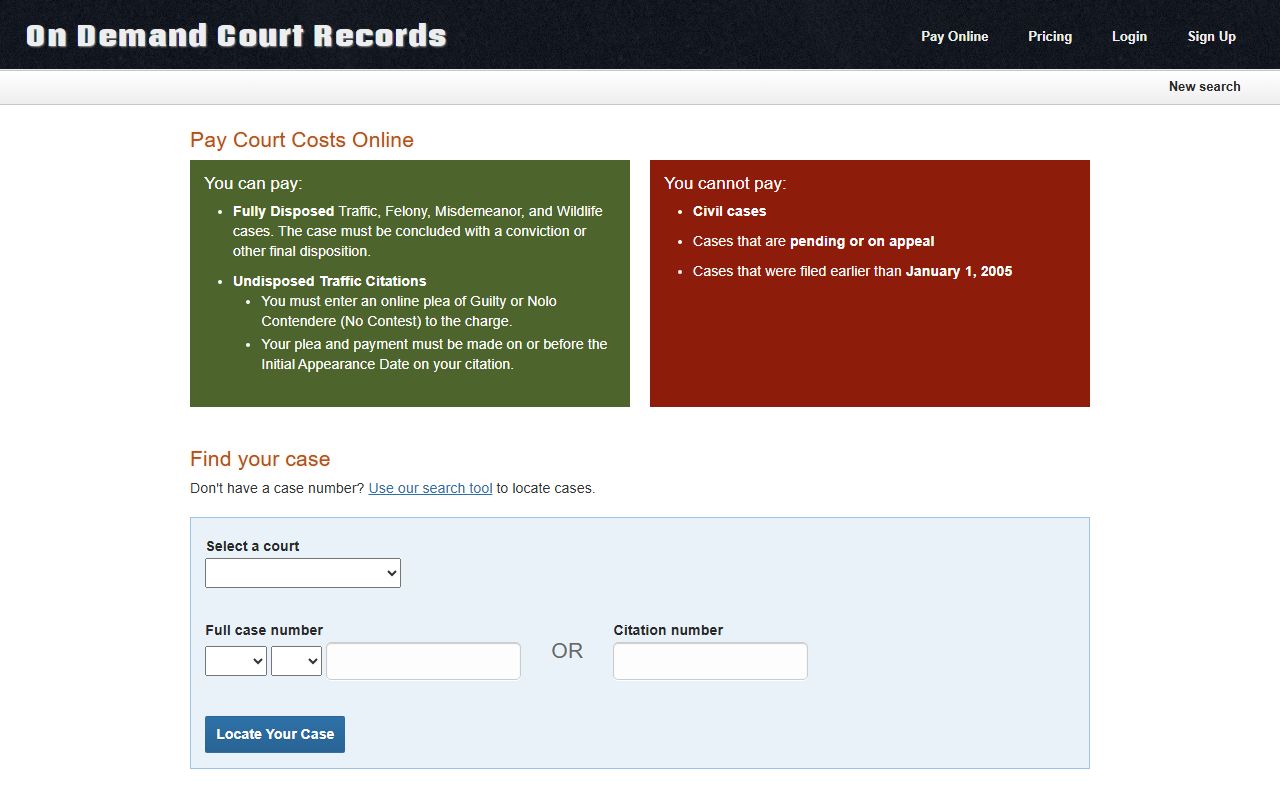
If your case does not qualify for the online portal, the Court Clerk still takes payment in person, by mail, or by phone. The steps below outline the full path from finding the ticket to confirming it is cleared.
- Identify whether the citation is a county or district case or a Sallisaw municipal ticket.
- For a county ticket, look up the case on ODCR and note the initial appearance date.
- To pay, use the ODCR portal where the case qualifies, or pay the Court Clerk in person, by mail, or by phone.
- To contest, enter a not-guilty plea and ask the Court Clerk for a hearing date.
- For a Sallisaw ticket, contact the municipal clerk and pay at City Hall or through Xpress Bill Pay.
- After paying or appearing, check the docket or payment record to confirm the matter closed.
Note: Missing the initial appearance date can trigger a bench warrant or extra court action, so handle a citation before its deadline passes.
Court Traffic Record vs State Driver Record
The single most common mix-up on traffic matters is treating the court file and the driving record as one thing. They are two separate records, kept by two different offices, built for two different purposes. The court file documents what happened with a citation in court. The state driving history tracks convictions, points, and license status over time. Paying a fine clears the court case but does not erase the conviction from the driving record.
| Comparison Point | Court Traffic Record | State Driver Record |
|---|---|---|
| Record source | Sequoyah County Court Clerk or Sallisaw Municipal Court | Oklahoma state driver licensing and public safety authority |
| What it contains | Citation, charge, court date, plea, disposition, fines, and warrant or FTA events | License status, posted convictions, suspensions, reinstatements, and CDL reporting |
| Where to access | ODCR, OSCN, or the clerk's office | The state driver-record channel, not confirmed in county sources; request it directly from the state |
| How to correct errors | Contact the Court Clerk or municipal clerk that holds the case | Contact the state driver licensing authority that maintains the history |
The official state driver-record portal was not located in the county sources reviewed, so do not treat ODCR as a driving history. For license status, points, and reinstatement questions, go to the state agency that issues driver licenses rather than the county court file.
CDL and Commercial Driver Records
Commercial drivers carry extra exposure on traffic tickets. A conviction on a commercial citation gets reported to the driving history and can reach the driver's employer and federal commercial records. The county court file shows the charge and outcome, but it does not display the license consequences a CDL holder faces. Because those consequences can be steep and the rules differ from ordinary tickets, a CDL driver should confirm how a Sequoyah County citation affects the commercial record with the state driver licensing authority before pleading or paying.
Sequoyah County DUI and DWI Cases
Driving under the influence is not a routine traffic ticket. DUI and DWI charges in Sequoyah County are filed as criminal cases, usually as misdemeanors or felonies, and they follow the criminal docket rather than the traffic track. They appear in ODCR and OSCN under criminal case types, and they can involve bond, an arraignment, and a sentence. For the full case file, charges, and outcome, see the Sequoyah County criminal court records page.
A DUI arrest can also lead to a jail booking, which connects the case to the county jail's communication tools. Booked inmates and their families use City Tele Coin for video visitation and messaging, and the City Tele Coin service page handles account setup.

That jail link matters mainly when a traffic stop turns into a criminal arrest. A standard speeding or equipment ticket never reaches the jail system; it stays a court fine matter from start to finish.
Deferred Sentences and Traffic Course Options
Oklahoma courts can offer a deferred sentence, a disposition where the judge holds off on a final judgment while the driver meets set conditions. When the conditions are completed, the case can end without a standard conviction entry. Whether a deferral, a driver-improvement course, or another alternative is available on a given Sequoyah County citation depends on the charge and the court. The official county sources reviewed do not publish a fixed traffic-school program, so confirm the options on your case with the Court Clerk before the appearance date.
Note: A deferred sentence still creates a court record and may still appear on the driving history, so it is not the same as having the ticket erased.
Sealing or Expunging Sequoyah County Traffic Records
Some traffic-related court records can be sealed under Oklahoma's expungement law. Sealing is filed in the District Court and requires the case to meet statutory eligibility, such as a dismissal, an acquittal, or a completed deferred sentence after a waiting period. A sealed case may still exist inside court and law-enforcement systems, but it should no longer appear as an ordinary public record on the docket.
The process runs under 22 O.S. Sections 18 and 19, which let a petitioner ask a district judge to seal qualifying records. The petitioner files the request, gives the required notice, and obtains a court order. Drivers who think a citation may qualify usually confirm eligibility with an attorney or the Court Clerk before filing.
Sequoyah County Traffic Record Fees and Payments
Fee figures for traffic copies are not published in the official county sources reviewed, so the exact charge for a plain or certified copy should be confirmed with the Court Clerk at 918-775-4411. What is documented is the cost of the online search tools and the ways the clerk accepts payment. ODCR keeps its basic docket search free, while advanced filters and scanned images sit behind monthly plans, the image tier being limited to active members of state bar associations. Copy requests and certified documents are handled through the Sequoyah County Court Clerk.
| Item | Amount |
|---|---|
| ODCR public docket search | Free |
| ODCR advanced tools (monthly) | $5.00 |
| ODCR scanned image access, attorneys (monthly) | $55.00 |
| Plain or certified copy from the Court Clerk | Confirm with Court Clerk |
| Traffic fines and court costs | Set by the court; confirm with Court Clerk |
The Court Clerk takes payment several ways. You can pay in person with cash, check, money order, or a debit or credit card. Mailed payments must use a cashier's check, personal check, or money order, never cash. Eligible cases can be paid online through ODCR, and the clerk also accepts card payments by phone at 918-775-4411.
Public Access Laws for Traffic Court Records
Traffic court records are public under Oklahoma law, which means most district traffic dockets are open to anyone who wants to look. The Oklahoma Open Records Act requires public bodies to give prompt, reasonable access to records unless a specific law makes them confidential. That framework is why ODCR and OSCN can post Sequoyah County traffic dockets for free public searching, with sensitive identifiers redacted.
Key Statutes:
Oklahoma Statutes Title 51, Section 24A.1 et seq. - the Open Records Act, requiring public access to government records unless a law restricts them.
Oklahoma Statutes Title 51, Section 24A.3 - defines a public record broadly to include documents and data files kept by public bodies.