
Criminal Court Records in Sequoyah County
A Sequoyah County criminal court record is the official case file the District Court builds after a prosecutor files charges. The Sequoyah County Court Clerk, Melanie Edgmon, records, files, and permanently keeps these District Court proceedings. Each file opens with the charging document and grows with every event that follows. It is the case-level record, not a simple arrest list. For a closer look at the charges themselves, the arrest records and court charges page explains how offenses are filed, amended, reduced, or dropped.
Most criminal cases in the county are heard by the Sequoyah County District Court, the state trial court of general jurisdiction. The county sits in Oklahoma's 15th Judicial District. Felony matters carry a CF case number and cover the most serious offenses. Misdemeanor matters carry a CM number and cover lesser crimes. City ordinance and municipal traffic offenses are handled separately by the Sallisaw Municipal Court. Serious federal crimes are prosecuted in another system entirely, the U.S. District Court for the Eastern District of Oklahoma.
Search Sequoyah County Criminal Court Records
Two free statewide tools carry Sequoyah County criminal dockets. On Demand Court Records, known as ODCR, lists the county in its court dropdown and offers free public docket searching. The Oklahoma State Courts Network docket search also shows Sequoyah County District Court as a court option. Either one returns case-level results when you know a name or a case number.
- Open the ODCR or OSCN search page and choose Sequoyah County District Court as the court.
- Enter the defendant name in last-name, first-name order, or type the full case number.
- Narrow the results by case type, such as criminal felony or criminal misdemeanor, and by filed date range.
- Open the matching case to read the docket, the charges, and the disposition.
- Request a certified copy from the Court Clerk if the file is image-gated, older, or not posted online.
Free ODCR searching covers partial names, case numbers, and full docket text. Advanced filters, including an offense filter and a date-of-birth field, sit behind a paid plan, and scanned district court images are limited to bar members. When the online record falls short, contact the Court Clerk at the courthouse, or browse all county filings through the broader Sequoyah County court records tools.
Stages of a Sequoyah County Criminal Case
A criminal case moves through fixed stages, and the court file captures each one. Reading the docket in order shows where a case stands and what comes next. The path runs the same way for felony and misdemeanor matters, though felonies add a preliminary hearing step before the case is bound over for trial.
Case flow: Charges Filed › Arraignment › Pretrial / Motions › Plea or Trial › Disposition › Sentencing
- Charges Filed. The district attorney files a complaint or information that lists the offenses and opens the case under a CF or CM number.
- Arraignment. The defendant first appears, hears the charges, learns of the right to counsel, and enters an initial plea. Bond may be set here.
- Pretrial and Motions. Both sides file motions, exchange evidence, and argue legal questions. Hearings, continuances, and bond changes are docketed.
- Plea or Trial. Most cases end in a plea. Others go to a bench or jury trial where guilt is decided.
- Disposition. The record notes the outcome of each count, such as guilty, dismissed, or acquitted.
- Sentencing. After a conviction or a deferred plea, the judge orders the penalty and the file records it.
Note: The Sequoyah County Court Clerk maintains the appearance docket, the plaintiff and defendant docket, and the journal docket for every criminal case.
What a Sequoyah County Criminal Record Shows
The public docket pulls together identity, charge, and outcome data in one place. A complete criminal file can include the charging instrument, parties, the assigned judge, every docket event, pleas, motions, warrants, bond activity, the disposition, the sentence, court costs, and payments. The fields below are the ones most readers look for first.
| Field | What It Shows |
|---|---|
| Case Number | The unique court ID and case type, such as CF for felony or CM for misdemeanor, plus the filing year. |
| Defendant | The name of the person charged, with the role marked as defendant on the party list. |
| Charges | The offense or offenses filed by the district attorney, listed count by count with the statute cited. |
| Docket Events | A dated log of filings, hearings, continuances, orders, and bond or warrant activity. |
| Plea | The defendant's formal answer, such as guilty, not guilty, or nolo contendere. |
| Disposition | The result for each charge, such as convicted, dismissed, deferred, or acquitted. |
| Sentence | The penalty after conviction, including jail or prison time, probation, fines, and restitution. |
Public portals do not show everything. Full Social Security numbers, sealed filings, protected juvenile details, and complete financial account numbers are redacted or withheld even when the rest of the case is open.
Charges vs. Convictions
A charge is an accusation. A conviction is a proven result. The two are easy to confuse on a docket, yet they mean very different things for the person named. A criminal court record can show charges that were later dropped, dismissed, or that ended in an acquittal, and those entries stay visible unless the file is sealed. Reading the disposition for each count is the only reliable way to tell an open accusation from a final conviction.
| Charge | Conviction | |
|---|---|---|
| Stage | Accusation at filing | Final verdict or plea |
| Who Decides | The district attorney | The judge or jury |
| Burden of Proof | Probable cause | Beyond a reasonable doubt |
| Can Still End In | Dismissal or acquittal | Sentence and penalty |
| Public Record | Yes | Yes |
Sequoyah County Criminal Dispositions and Sentences
The disposition line closes the story on each count. Some codes appear often in Oklahoma criminal files, and a few carry consequences that are easy to miss. A nolo contendere plea, for example, is treated like a conviction for the case at hand. A deferred sentence can let a charge fall away once conditions are met, which is why the same case may read differently a year apart.
- Guilty / Convicted
- The defendant admitted the charge or was found guilty, and the conviction stands on the record.
- Nolo contendere
- A no-contest plea accepted by the court and treated like a conviction for that case.
- Deferred sentence
- Judgment is held off while the defendant meets court conditions, often probation and costs.
- Dismissed
- The charge was dropped. Dismissed with prejudice cannot be refiled; without prejudice may return.
- Acquitted
- A trial ended in a not-guilty finding on that count.
The sentence entry follows the disposition. It can list prison or jail time, a suspended term, probation, fines, court costs, and restitution to a victim. Some county sentences route a defendant into structured supervision instead of jail through the local Community Sentencing program.
Who Prosecutes Sequoyah County Criminal Cases
Charges do not appear in the court file on their own. A prosecutor reviews each arrest and decides which offenses to file. In Sequoyah County that work belongs to the District 27 District Attorney, Jack Thorp, whose office serves Adair, Cherokee, Sequoyah, and Wagoner Counties. The office reviews evidence, files the complaint or information, negotiates pleas, and carries the case through trial and sentencing.
Sallisaw, OK 74955
Phone: 918-775-9131
Hours: Mon-Fri 8:00 am - 4:00 pm
Statewide context for the district sits on the Oklahoma District Attorneys Council District 27 page, and the local office profile is on the county district attorney page. A defendant who cannot afford a lawyer may be assigned counsel through the Oklahoma Indigent Defense System, which contracts for Sequoyah County representation.
Criminal History Checks for Sequoyah County
A single county docket shows one case at a time. For a complete picture across the state, the Oklahoma State Bureau of Investigation keeps the central criminal history. The agency lays out its name-based and fingerprint-based options on its how to request a background check page.
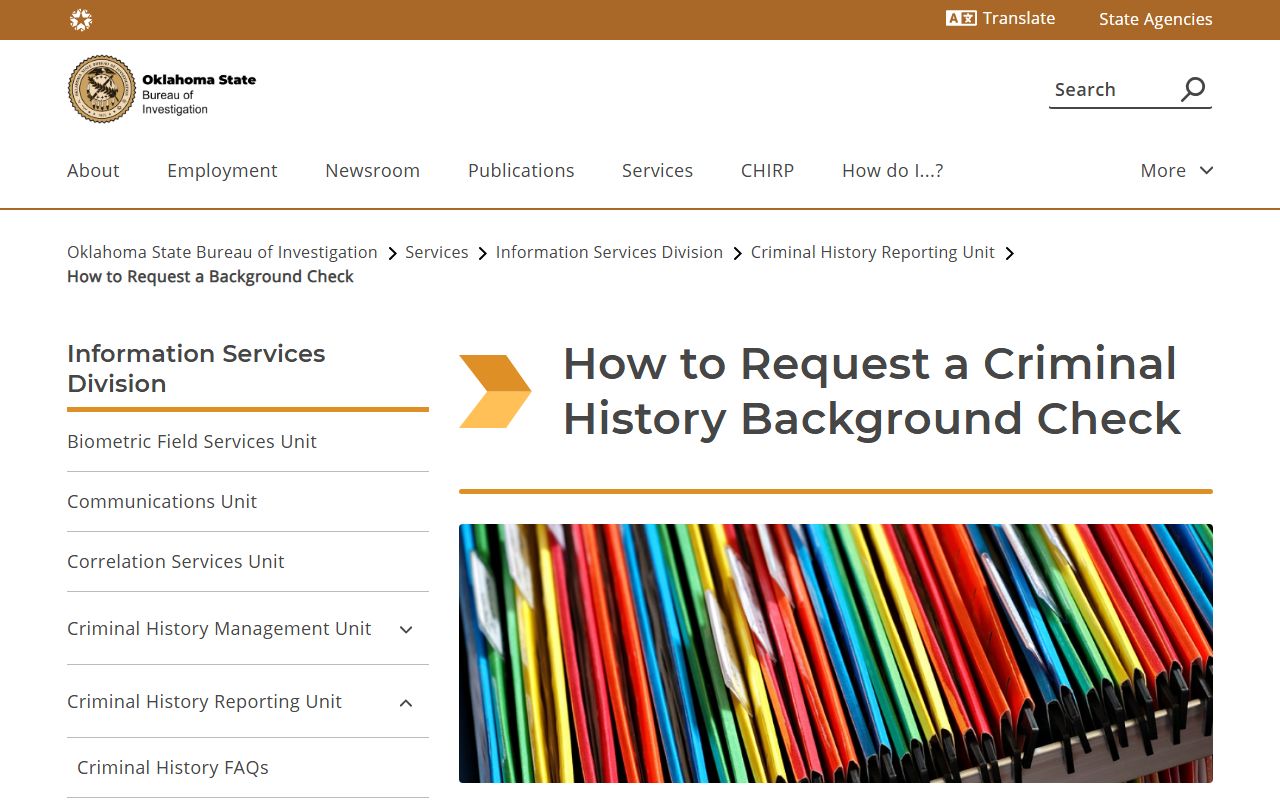
Each request type carries its own fee and turnaround, and a fingerprint search reaches further than a name match alone. The quickest route runs online through the bureau's portal.
The OSBI CHIRP portal lets a requester order a name-based Oklahoma criminal history check over the internet without mailing a form.
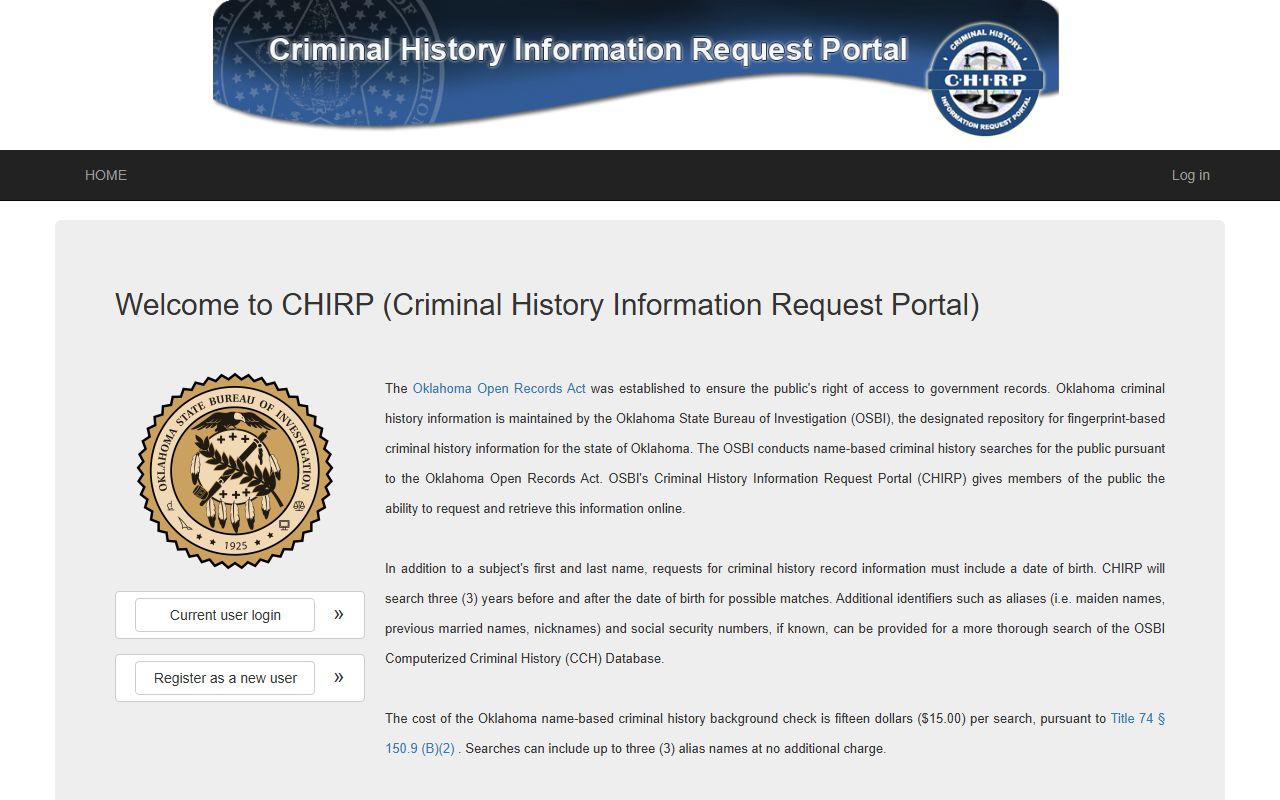
A CHIRP result reflects records reported to the state and may not include every county docket event, so it works best alongside an ODCR or OSCN search.
Important: This website is not a consumer reporting agency under the Fair Credit Reporting Act, and its records may not be used for employment, credit, tenant, or insurance screening.
State Custody and Offender Records
When a Sequoyah County conviction leads to a prison term, the record moves into the state corrections system. The Oklahoma Department of Corrections homepage links to an offender lookup and to its open-records request process.
The corrections site is where a sentenced offender's status sits after the county case closes. Details on what those files hold appear on the agency's records guidance.
The department's offender information page explains how to request records and notes which materials are closed to the public.
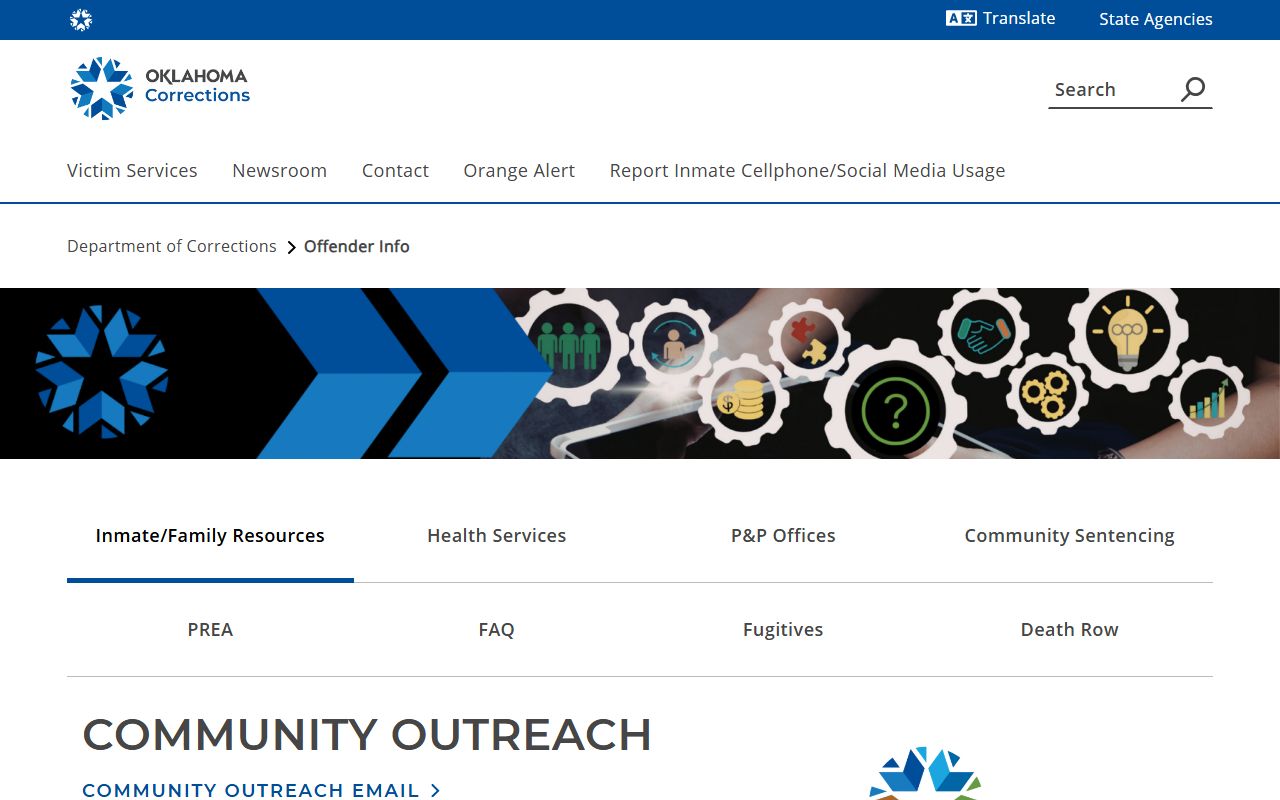
For a quick status check on a specific person, the agency runs a public search tool.
The Oklahoma DOC offender lookup returns statewide custody and supervision status, though the agency warns the listing is abbreviated and not an exact account of the offense or sentence.
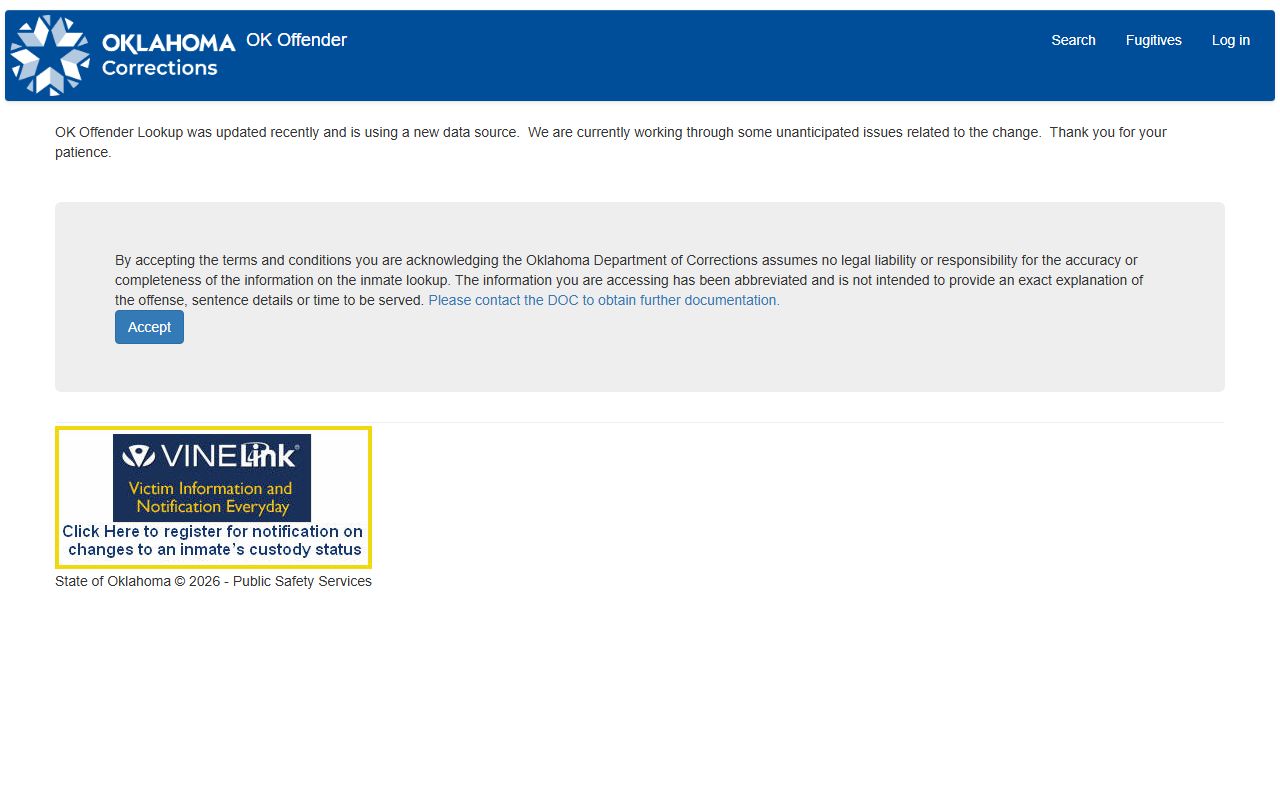
This lookup covers sentenced state prisoners and people under supervision, not pretrial inmates held in the county jail. For current jail bookings, the Sequoyah County inmate records page tracks the sheriff's roster.
Federal Criminal Cases From Sequoyah County
Not every serious crime stays in state court. Sequoyah County falls within the U.S. District Court for the Eastern District of Oklahoma, and eastern Oklahoma sees many federal prosecutions tied to Indian Country jurisdiction. Federal firearms, drug, and violent offenses involving county residents are prosecuted by the U.S. Attorney's Office for the Eastern District of Oklahoma.
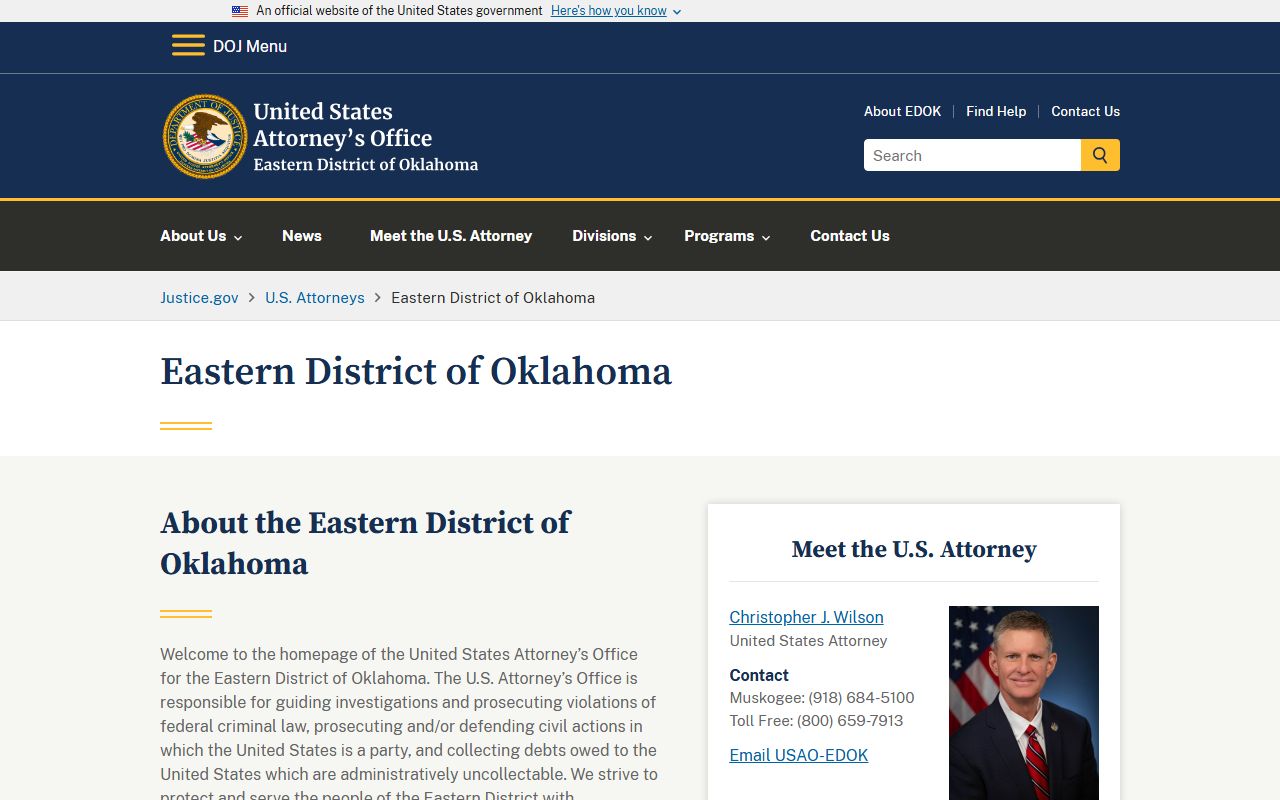
Federal case files are not posted on ODCR or OSCN. They are searched through PACER and the court's CM/ECF system, reached from the Eastern District court homepage. The federal venue for the district centers on Muskogee, and federal appeals go to the U.S. Court of Appeals for the Tenth Circuit.
Public Access to Sequoyah County Criminal Records
Oklahoma treats most criminal court files as open public records. The starting rule is the Oklahoma Open Records Act, which requires public bodies to give prompt, reasonable access unless a specific law makes a record confidential. Court dockets, charging documents, and dispositions generally fall on the public side of that line. The same statutes set out the narrow categories that stay sealed.
Key Statutes:
Oklahoma Open Records Act, 51 O.S. §§ 24A.1 et seq. - public bodies must provide prompt access to public records unless a law makes them confidential.
22 O.S. §§ 18-19 - sets the grounds and process for sealing or expunging qualifying criminal records through the district court.
10A O.S. § 1-6-102 - keeps many juvenile records confidential and closed to general public inspection.
Note: For older, image-gated, or unindexed criminal files, the Sequoyah County Court Clerk at 918-775-4411 is the office that confirms what is releasable.
Sealed vs. Expunged Records
Oklahoma law lets some people remove a criminal record from public view. Sealing and expungement are related but not identical, and both run through a petition filed in the District Court under 22 O.S. Sections 18 and 19. Eligibility depends on the outcome of the case and any waiting period the statute requires. Common qualifying grounds include an acquittal, a dismissal, or a completed deferred sentence after the set time has passed.
| Sealed | Expunged | |
|---|---|---|
| Visibility | Hidden from public search | Treated as if it never existed |
| Law Enforcement | Limited access remains | Very limited access |
| How It Happens | Court order on petition | Court order on petition |
| Oklahoma Basis | 22 O.S. §§ 18-19 | 22 O.S. §§ 18-19 |
A sealed case may still exist in court or law-enforcement systems, but it should not show up in an ordinary public docket search. The petitioner files in the district court, gives required notice, and asks the judge for an order sealing the court and criminal-history records.
Restricted Sequoyah County Criminal Records
Some criminal matters never reach the public docket at all. Juvenile cases are commonly confidential under Oklahoma juvenile rules, with access limited to the juvenile, a parent or guardian, counsel, the court, or named agencies. Mental health case records and medical information tied to a defendant are treated as restricted, even though the county runs a Mental Health Court Coordination program. Adoption files are likewise closed.
Active investigations and warrants can also sit outside public view until the court allows release. Bench warrants, failure-to-appear events, and search warrant filings may appear in the docket, but live warrant detail is best confirmed through the issuing court or the sheriff. For that step, the Sequoyah County warrant records page outlines the available channels. When a record is sealed, redacted, or withheld, the Court Clerk can confirm whether any part of the file is releasable.