
Sequoyah County Arrest Records and Court Charges
An arrest record in Sequoyah County documents the arrest itself. It shows who was taken into custody, the arresting agency, the booking date and time, and the offenses listed at the time of booking. The Sequoyah County Sheriff's Office handles booking at the county jail in Sallisaw. An arrest, on its own, is only an accusation. It does not mean a prosecutor filed charges, and it does not mean a court found anyone guilty.
The court charge record is a separate thing. After an arrest, the District Attorney for District 27 reviews the case and decides the formal charges. Those charges are filed with the Court Clerk and tracked through the district court case from start to finish. The booking side, including the Sequoyah County jail roster and booking detail, sits with the sheriff, so the Sequoyah County inmate records page is the better source for current custody status. For the full case file, pleas, and final outcome, the criminal court records page follows a charge through to disposition and sentence.
The sheriff posts a rolling snapshot of recent jail activity in its 72-hour booking report.
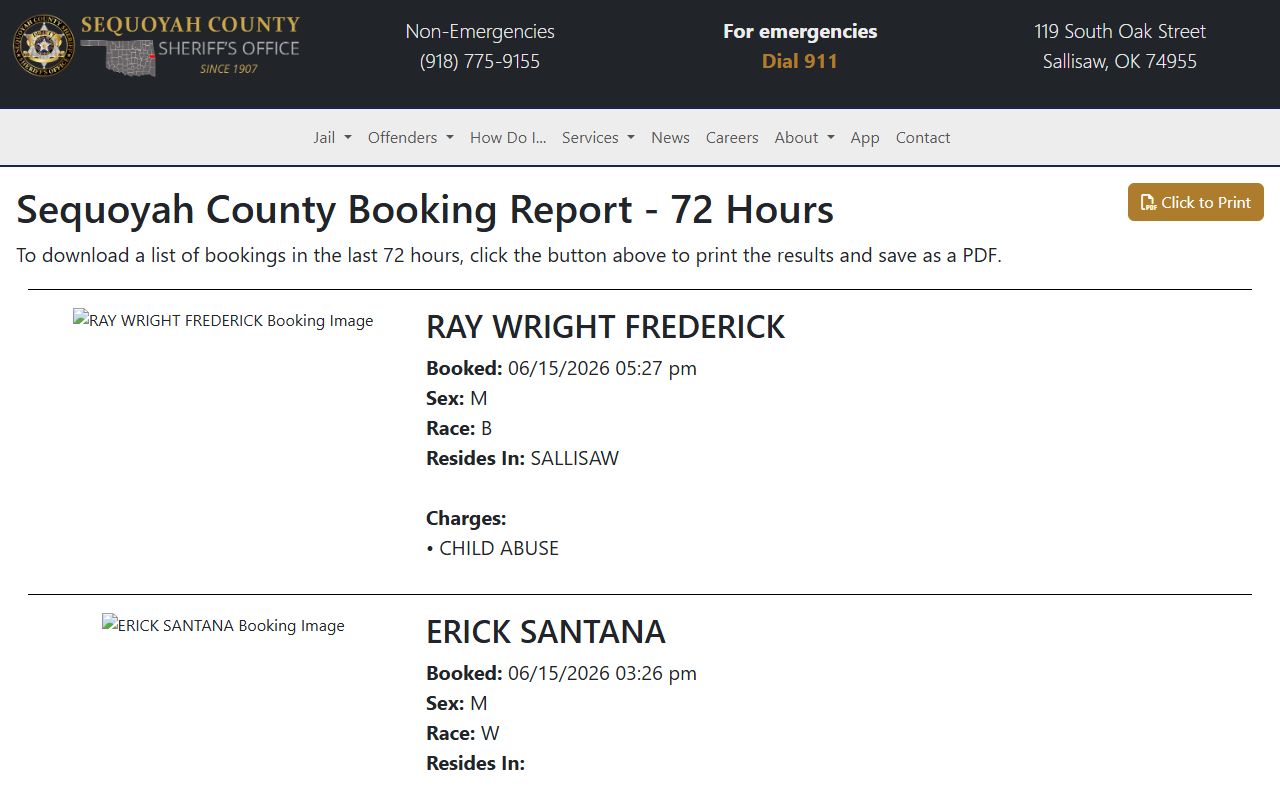
That report lists names, the charges noted at booking, and basic descriptors such as sex and race. It is the arrest-side view, captured before the prosecutor files anything in court. The charges on a booking report can differ from the charges that end up on the court docket.
How to Find Sequoyah County Arrest Records and Charges
Filed charges show up in the Sequoyah County district court case index, not in a stand-alone arrest database. Sequoyah County takes part in two free public search systems. On Demand Court Records, known as ODCR, and the Oklahoma State Courts Network, known as OSCN, both let you search by name or case number and read the charge list on a case. Arrest and booking detail that never reaches the court stays with the sheriff instead.
- Open ODCR and pick Sequoyah from the court list, or use the OSCN docket search and choose Sequoyah County District Court.
- Search by defendant name in last, first order, or enter the full case number with its prefix and year.
- Open the matching case to see the charges as filed, with each offense listed on its own line.
- Check each charge's statute code, level, and current status in the docket entries.
ODCR keeps its basic search free and unlimited. A five dollar monthly advanced plan adds filters for offense or cause and an outstanding warrant filter. For records the court never received, such as an incident report or a booking record not posted online, the Sheriff's Records Division takes requests in person at the county jail.
Note: A booking charge and the charge the prosecutor files can differ, so confirm the filed charge on the court docket rather than the arrest list alone.
How Charges Get Filed After a Sequoyah County Arrest
The Sequoyah County charge record begins when a prosecutor commits the accusation to paper. After booking, the District Attorney decides whether to file, decline, or amend the offenses an officer listed. The formal accusation arrives in one of three documents. A complaint and an information are written and signed by the prosecutor, while an indictment is voted by a grand jury. In Oklahoma district court practice, most felonies and misdemeanors move forward on a written information.
| Complaint | Information | Indictment | |
|---|---|---|---|
| Filed By | Officer or prosecutor | Prosecutor | Grand jury |
| Common For | Misdemeanors and early stages | Many felonies and misdemeanors | Serious felonies |
| Starts | The case | The case | The case |
An information is the prosecutor's formal charge document, and it is the route most county criminal cases take. The document names the defendant, lists each count, and cites the statute the charge rests on. Once it is filed with the Court Clerk, the charge becomes a public part of the district court record.
Charge Codes and Severity Levels in Oklahoma
Each charge is tied to a specific statute, and the case number prefix signals the severity level. A single Sequoyah County arrest can spin off several separate charges, and they do not all have to share the same level. Felony counts carry the heaviest possible punishment, misdemeanor counts are lower-level offenses, and traffic or wildlife matters fall under their own categories. The case prefix is the quickest way to read severity at a glance.
- CF marks a criminal felony case.
- CM marks a criminal misdemeanor case.
- TR and TRC mark traffic cases.
- WL marks a wildlife case.
- SW marks a search warrant filing.
A felony is a serious crime that can bring a prison term, while a misdemeanor is a lesser offense usually punished by a county jail term, a fine, or both. The charge list on a case can mix levels, so one defendant may face a felony count alongside one or more misdemeanor counts from the same incident.
Charge Status in Sequoyah County Court Records
Charges rarely sit still. As a case moves through Sequoyah County district court, counts can be amended, reduced, added, dropped, or dismissed. The docket records each change, so the status you see today may not match the offense listed at booking. Reading the current status matters more than reading the first charge filed, because the status tells you where the count actually stands.
| Status | What It Means |
|---|---|
| Pending | The charge is filed and the case is still open, with no final outcome entered yet. |
| Amended / Reduced | The prosecutor changed the count, often lowering a felony to a misdemeanor or swapping one offense for another. |
| Dismissed | The court dropped the charge; a dismissal without prejudice can be refiled, while one with prejudice cannot. |
| Nolle Prosequi | The prosecutor formally chose not to pursue the charge, ending it without a finding of guilt. |
Statewide Charge and Criminal History Lookups
A docket search shows charges filed in Sequoyah County, but it will not pull a person's full record from across Oklahoma. For a statewide criminal history, the Oklahoma State Bureau of Investigation runs the official channel beyond the Sequoyah County court index. Its online portal, CHIRP, accepts name-based requests and returns an OSBI criminal history report drawn from arrests and dispositions reported by agencies statewide.
You can start a request through the OSBI CHIRP portal or follow the agency's background check instructions. An OSBI report is the right tool when you need charges that may have been filed in more than one county, since the county portals only cover their own district court cases.
Note: County court searches and a statewide OSBI history are different records, so a clean local docket does not rule out charges filed elsewhere in Oklahoma.
Charges vs. Convictions
Being charged is not the same as being convicted, and a Sequoyah County arrest record can show one without the other. A charge is an accusation that a prosecutor can support with probable cause, the low bar needed to file. A conviction comes only after a guilty plea, a no-contest plea, or a verdict, and it requires proof beyond a reasonable doubt. Both the charge and the conviction can appear in the public record, which is why a record showing a charge tells you only part of the story.
| Charge | Conviction | |
|---|---|---|
| Stage | Accusation | Verdict or plea |
| Burden of Proof | Probable cause | Beyond a reasonable doubt |
| Public Record | Yes | Yes |
Sealed and Expunged Sequoyah County Charge Records
Some charge records do not stay open to the public. Under Oklahoma law at 22 O.S. Sections 18 and 19, a person can petition the Sequoyah County district court to seal qualifying arrest and case records. Common grounds include an acquittal, a case where no charges were filed, a completed deferred sentence after a waiting period, and certain misdemeanor or nonviolent felony categories. The petitioner files in the district court, gives the required notice, and asks for an order. The two outcomes work differently.
- Sealed
- The record still exists in court and law enforcement systems, but the public docket should no longer disclose it as an ordinary public record. Access becomes limited.
- Expunged
- The record is treated as though it never happened for most purposes, and access is even more tightly restricted than a sealed file.
A sealed case can still surface in limited law enforcement settings, so sealing is not the same as total erasure. Eligibility under the Oklahoma statute depends on the offense, the outcome, and the waiting period, which is why two people with similar charges can reach different results.
Sequoyah County Sheriff Records and Recent Arrests
When a record is not posted online, the sheriff is the next stop for arrest and incident detail. The Sequoyah County Sheriff's Office runs the county jail and keeps the booking and report files that sit behind a public roster. Its records channel is in person rather than a web form, so plan a visit during the posted window. A victim is entitled to one free copy of an incident report, must appear in person, and must show acceptable identity verification.
You can review the request rules on the Sheriff's records request page.
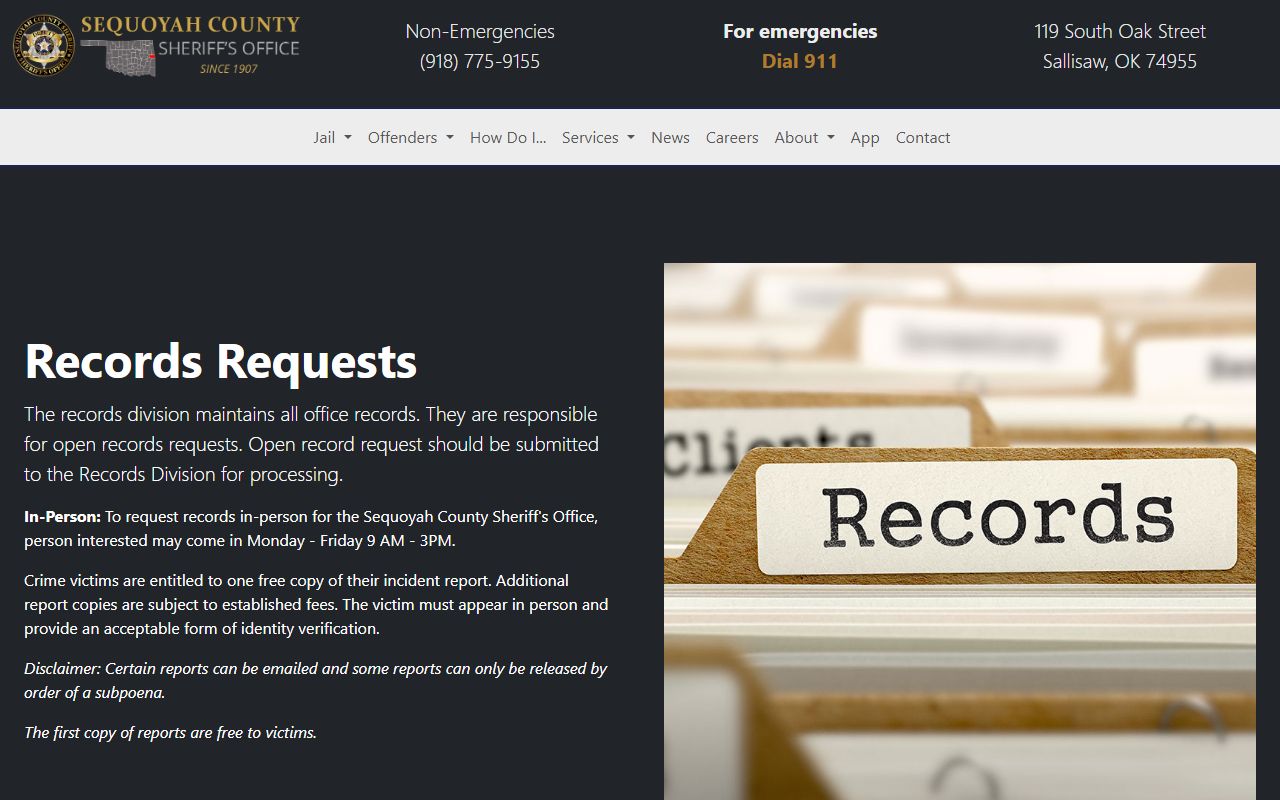
The Records Division accepts in-person requests Monday through Friday from 9 AM to 3 PM. Some reports can be emailed once verified, while others require a subpoena before release. For charge detail tied to a filed case, the court docket remains the better source, since the sheriff handles the arrest and report side rather than the prosecution.
Sequoyah County Sheriff's Office
119 South Oak Street
Sallisaw, OK 74955
Main: 918-775-1214
Dispatch: 918-775-9155
Records hours: Mon-Fri 9:00 AM - 3:00 PM
The office also publishes a Sequoyah County Sheriff's Office mobile app that pulls recent arrests, inmate information, wanted persons, and tip submission into one place. The website spreads those tools across separate roster, most wanted, and tip pages, so the app is the quickest mobile route. You can flag a crime through the sheriff's online tip form.
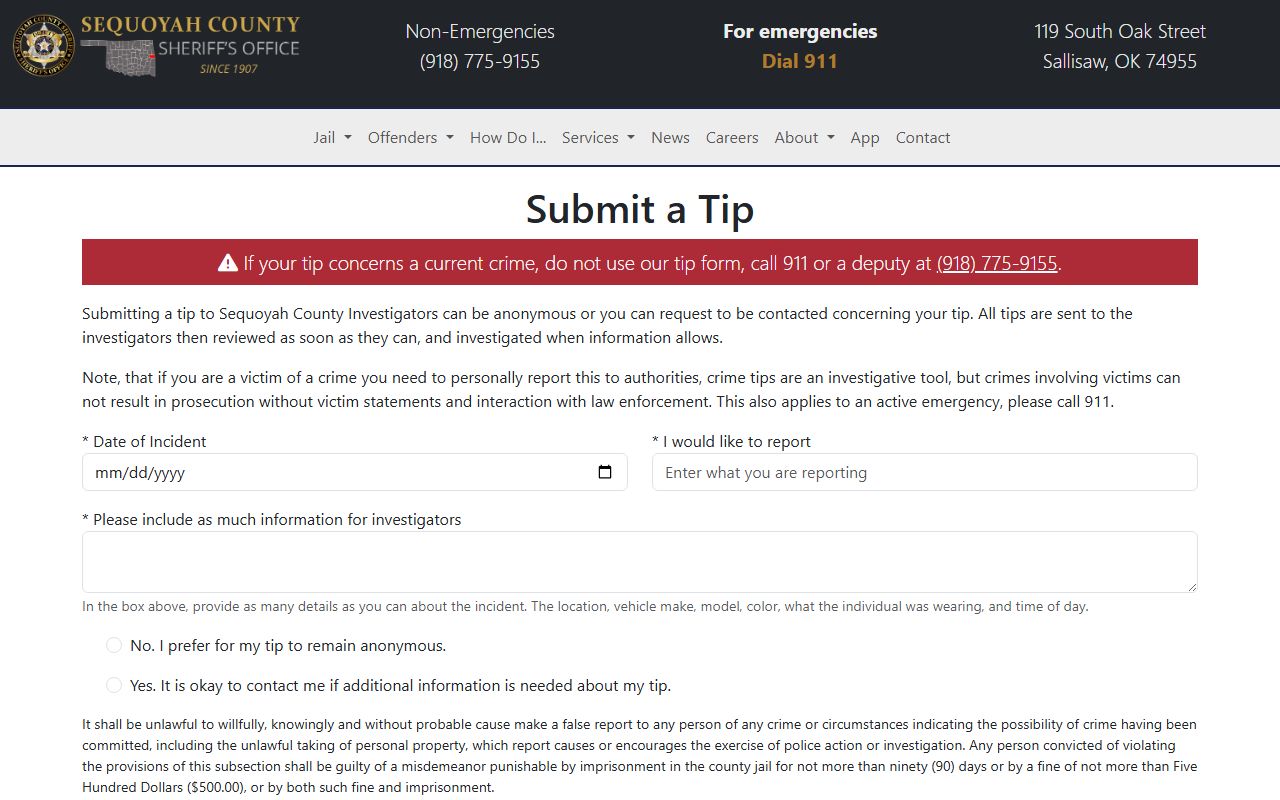
The tip form takes an incident date, a narrative, and optional contact fields, and it lets you stay anonymous. The page warns that a false report can be a misdemeanor punishable by up to 90 days in county jail, a fine of up to 500 dollars, or both. Wanted-person listings on the sheriff's Most Wanted page carry a disclaimer that the list is not current for legal purposes.
Federal Charges Filed Against Sequoyah County Residents
Not every charge involving a Sequoyah County resident lands in the county district court. Sequoyah County falls within the U.S. District Court for the Eastern District of Oklahoma, and federal prosecutors handle offenses such as firearms, drug conspiracy, and many Indian Country crimes. Those cases are searched through PACER, the federal court system, rather than ODCR or OSCN. The U.S. Attorney's Office for the Eastern District announces many of these charges and sentences as they happen.
Recent announcements are posted on the U.S. Attorney Eastern District press release page.
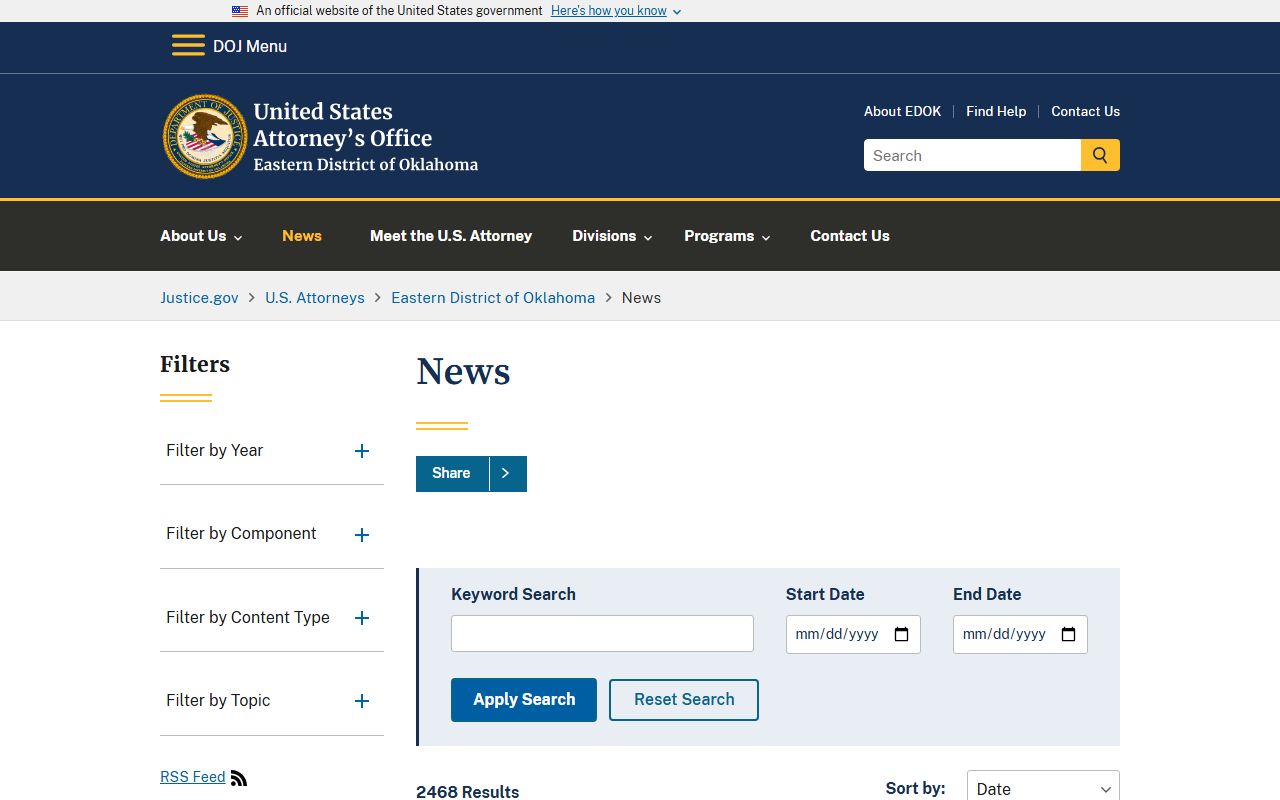
One June 2026 release reported that a Gore resident was sentenced to 27 months for possessing a firearm after a domestic violence conviction, in an investigation that involved the Sequoyah County Sheriff's Office. Cases like that show the split between a county arrest and a federal charge, since the same local investigation can end up in federal court.
Background Check Considerations
A casual name search and a formal background check are not the same thing. Looking up charges through a Sequoyah County court portal helps you understand a single case, but it does not produce a screened report fit for a hiring or housing decision. Background checks used for employment, tenancy, or credit fall under the Fair Credit Reporting Act and must run through a regulated consumer reporting agency. For a defensible Oklahoma criminal history, the OSBI report is the appropriate official source.
Important: This site is not a consumer reporting agency under the Fair Credit Reporting Act, and its information may not be used for employment, tenant, credit, or insurance screening.
Restricted Charge Records in Sequoyah County
Public access to Sequoyah County charge records is broad in Oklahoma, but several categories are held back. Juvenile charges are commonly confidential under 10A O.S. Section 1-6-102, so they usually do not appear in a public docket search. Sealed and expunged charges are withheld from the ordinary public record, and active investigations can keep arrest detail out of view until charges are filed or the matter resolves.
The Oklahoma Open Records Act, found at 51 O.S. Sections 24A.1 and following, sets the default that public bodies must give reasonable access unless a specific law makes a record confidential. Sensitive identifiers such as full Social Security numbers, protected juvenile details, and victim information are redacted rather than released, so a record you can view may still arrive with parts blacked out.
Note: A blank result in a county portal does not always mean no charges exist, because the record may be sealed, juvenile, or simply not yet indexed online.