
Probate in Sequoyah County District Court
Oklahoma does not run a stand-alone probate court. Probate is a division of the District Court, and Sequoyah County handles every estate, will, guardianship, and trust matter through that single trial court. The Sequoyah County Court Clerk works directly with the probate division, recording each filing and maintaining the permanent case file. That means the same office that holds civil and family cases also holds the county's probate docket.
Probate covers more than the reading of a will. It includes administering the estates of people who die with a will and those who die without one, appointing a personal representative, settling debts, and distributing what remains to heirs. Guardianship cases protect minors and adults who cannot care for themselves. Conservatorship and trust proceedings deal with the management of property and assets under court supervision.
Because the District Court hears all of these, a single search of the county court system reaches every type of probate case. The Court Clerk's office sits inside the Sequoyah County Courthouse in Sallisaw, where staff can pull files, explain the docket, and process copy requests in person or by phone.
Probate Terms Defined
Probate filings use words that rarely come up in daily life. A quick read of the most common terms makes a Sequoyah County case file far easier to follow before you start a search.
- Testator
- The person who made the will. When that person dies, the will is offered to the court for proof.
- Executor
- The person named in a will to carry out its instructions, also called a personal representative once the court appoints them.
- Intestate
- Dying without a valid will, in which case state law decides who inherits and the court appoints an administrator.
- Guardianship
- A court arrangement giving one person legal authority to care for a minor or an adult who cannot manage personal needs.
- Conservatorship
- A court arrangement placing a person's property and financial affairs under the management of an appointed conservator.
How to Search Sequoyah County Probate Records
The fastest way to find a probate case is the statewide court-record portals that publish Sequoyah County District Court data. On Demand Court Records, known as ODCR, lets you search by party name or case type for free. When ODCR results look thin, the Oklahoma State Courts Network docket search covers the same county court and adds broader docket detail. Both index probate filings, but neither posts the scanned will or full estate documents online for the general public.
- Open ODCR and set the Court field to Sequoyah, then choose a probate category under Type of case, such as Probate Proceedings, Probate Miscellaneous, Guardianships, Conservatorship, Trust Proceedings, or Filing of Wills.
- Enter a party name for the decedent, ward, petitioner, personal representative, guardian, trustee, or other interested party, using the Last, First format the portal expects.
- Switch to OSCN if the ODCR results are incomplete, and search the same name or case number against the Sequoyah County District Court option there.
- Contact the Court Clerk at 918-775-4411 for certified copies, sealed or older files, original wills, or guardianship records that are not posted online.
Probate cases carry their own prefix in the case number. Look for PB or PR at the front of a number, which marks the file as a probate matter and separates it from civil, criminal, or family cases on the same docket.
Sequoyah County Probate Case Types
The county court system breaks probate into several searchable categories. Knowing which one fits your situation narrows a search quickly and helps you avoid scrolling through unrelated cases. The ODCR and OSCN dropdowns expose each of these as a distinct case type for Sequoyah County District Court.
- Probate Proceedings for administering an estate, with or without a will.
- Probate Miscellaneous for smaller or related estate filings.
- Guardianships for the care of minors and incapacitated adults.
- Conservatorship for the management of a protected person's property.
- Trust Proceedings for disputes and administration of trusts.
- Filing of Wills and Wills for documents lodged with the court.
A single family situation can produce more than one of these. An estate with a minor heir, for example, may open both a probate proceeding and a guardianship case at the same time. Searching a family name across several categories often surfaces the full picture.
Court Clerk Probate Division Contact
The Sequoyah County Court Clerk is the office of record for every probate filing in the county. Melanie Edgmon serves as Court Clerk, and her staff handles civil, probate, juvenile, domestic relations, and small claims matters. For an original will, a certified letter of administration, or a file that predates the online index, the clerk's counter is the place to go.
Sequoyah County Court Clerk – Probate Division
120 E. Chickasaw Ave., Suite 205
Sallisaw, OK 74955
918-775-4411
Monday–Friday, 8:00 a.m. to 4:00 p.m. (open noon)
Payments to the clerk can be made in person by cash, check, money order, or card, by mail without cash, online through ODCR for eligible items, or by phone with a card. Call ahead if you are traveling for a specific file, since older probate records may be stored off the immediate counter.
Sequoyah County Probate Filing Fees
Probate carries court costs at filing and again for the certified copies that estates and guardianships usually require. Oklahoma sets many district-court fees by statute, but the exact Sequoyah County probate amounts were not published in the official county sources reviewed for this page. Treat the figures below as items to confirm rather than fixed prices.
| Item | Amount |
|---|---|
| Original probate application | Confirm with Court Clerk, 918-775-4411 |
| Letters testamentary or of administration | Confirm with Court Clerk, 918-775-4411 |
| Certified copy, per page | Confirm with Court Clerk, 918-775-4411 |
| Guardianship application | Confirm with Court Clerk, 918-775-4411 |
Call the Court Clerk before filing or ordering copies so you bring the right payment method and the correct amount. The office accepts several forms of payment, and the staff can quote the current cost for the specific document you need.
Note: Probate filing fees were not located in official Sequoyah County sources, so verify every amount with the Court Clerk at 918-775-4411 before you file or request copies.
What Sequoyah County Probate Records Show
A probate file grows as a case moves through the court, so the docket reads as a timeline of estate or guardianship events. Early entries open the case and identify the people involved. Later entries track the work of settling debts, accounting for property, and closing the matter.
Most Sequoyah County probate records include the following fields and document types. The public docket shows the index of these entries even when the underlying scanned image stays at the courthouse.
| Field or Document | What It Shows |
|---|---|
| Case number and type | The PB or PR file number and the probate category. |
| Decedent, ward, or trust name | The person or trust at the center of the case. |
| Petitioner and personal representative | Who opened the case and who manages the estate. |
| Attorneys and filing date | Counsel of record and the date the case began. |
| Notices and hearings | Creditor notices and scheduled court dates. |
| Orders and letters | Order admitting the will and letters testamentary or of administration. |
| Inventory and accounting | The estate's assets and the representative's financial reports. |
| Final decree and closure | The decree of distribution, guardianship orders, and case closing. |
Guardianship and conservatorship files follow a similar pattern but center on the protected person rather than an estate. They record the appointment, the powers granted, periodic reports, and any order ending the arrangement.
Restricted Guardianship Records in Sequoyah County
Not every probate document is open for public viewing. Guardianship cases often contain confidential medical evaluations, capacity reports, and personal details about a ward. Courts can restrict or redact those materials even when the case index itself stays public.
Records involving minors carry the strongest protection. A guardianship over a child can overlap with juvenile matters, and Oklahoma keeps many juvenile records confidential. Mental health information attached to a conservatorship or capacity proceeding is also treated as restricted rather than ordinary public record. When a file is sealed, the public docket should not disclose its contents as a normal open record.
If a search returns a case label but no detail, that gap usually reflects a privacy rule, not a portal error. The Court Clerk can explain what is releasable and what requires a court order or a showing of standing before release.
Requesting Copies of Sequoyah County Probate Records
Online dockets are fine for a quick look, but estates, banks, and title companies usually need certified paper. A certified copy carries the clerk's seal and proves the document is genuine, which an uncertified printout cannot do.
To order copies, contact the Sequoyah County Court Clerk with the case number and the names involved. Staff can locate the file, confirm the per-page cost, and certify the pages you need. Older probate files that never reached the online index are available the same way, so a missing search result does not mean a record was lost. The same office also issues marriage licenses and handles the county's marriage and divorce records, and its full duties are covered on the Court Clerk page.
Bring identification and a payment method that the office accepts. For mailed requests, include a daytime phone number so the clerk can reach you about the cost before processing.
County Probate Versus Federal Court Matters
County probate and federal court are separate systems, and it helps to know which one holds the record you want. Sequoyah County sits in the U.S. District Court for the Eastern District of Oklahoma, whose official homepage handles federal cases through PACER and CM/ECF rather than the county docket. Estates and guardianships are not federal matters, so they will never appear on that court's system.
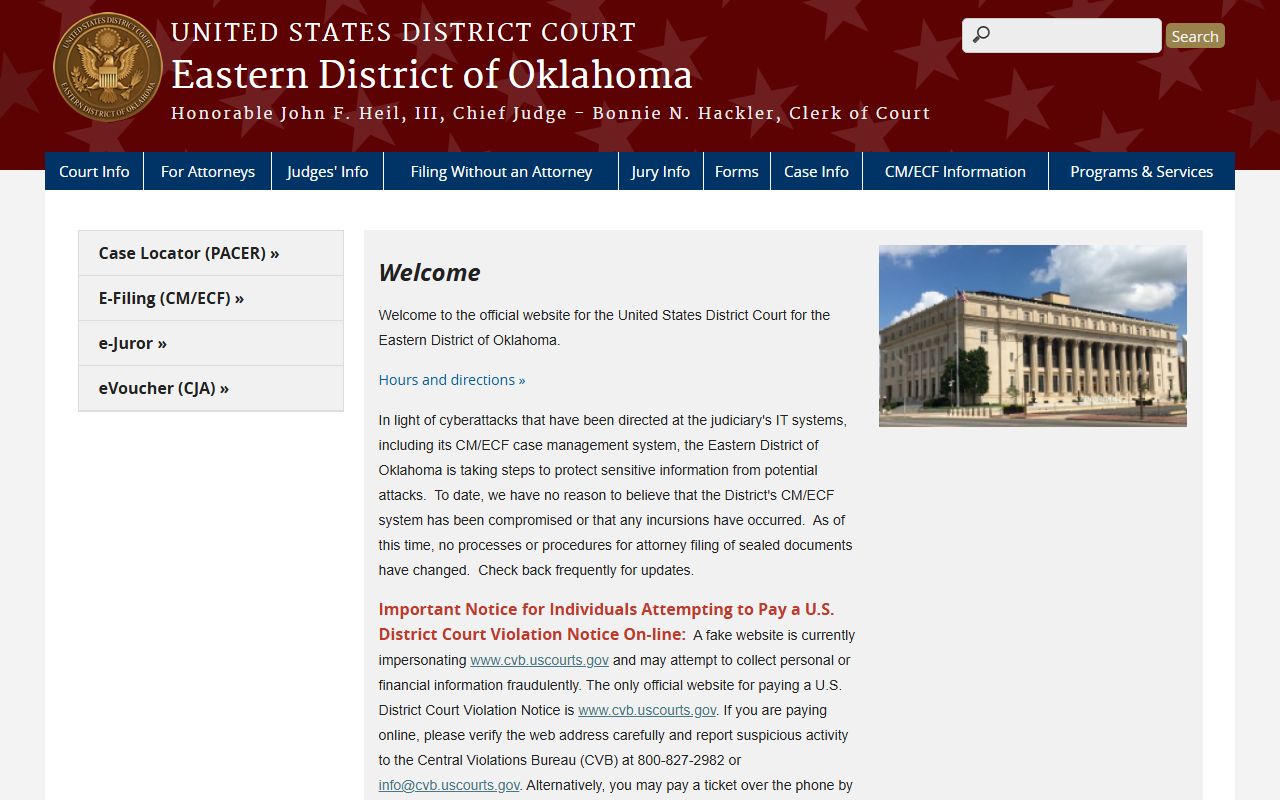
That federal homepage is the gateway for federal civil and criminal cases tied to the county, none of which are probate files. It exists here only to mark the boundary between the two court systems so a probate searcher does not waste time on the wrong portal.
The court's plain-language overview of the federal court system explains how district courts fit into the national structure and lists the counties the Eastern District covers, Sequoyah among them. Reading it makes the split clear: federal estate tax disputes, Indian Country matters, and other federal questions live in that court, while the will, the guardianship, and the everyday estate stay with the county.
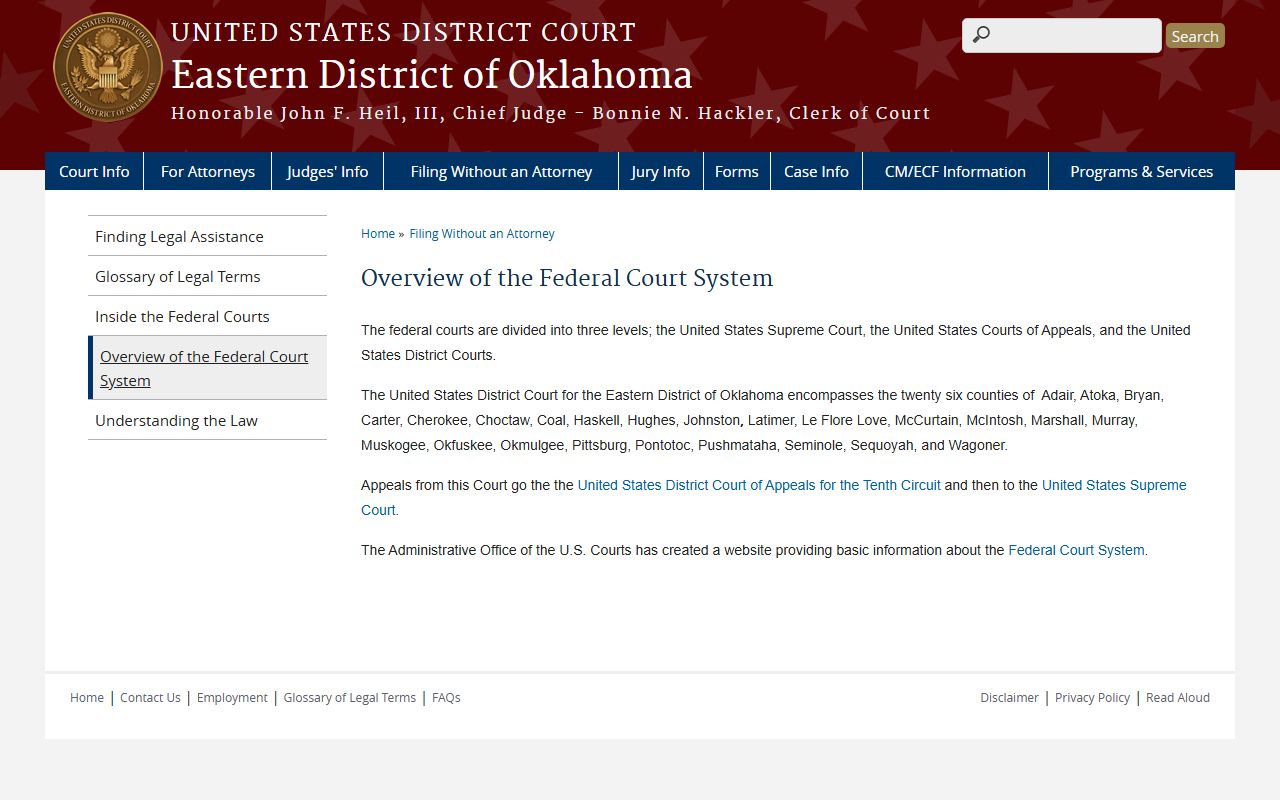
The overview is a useful map of where federal authority begins, but it is not a probate resource. For a county estate, the search still starts at ODCR or the Court Clerk, not the federal court.
The county's place in the Eastern District is fixed by statute. The federal code at 28 U.S.C. Section 116 names Sequoyah County as part of the Eastern District of Oklahoma, which is why federal matters from Sallisaw route to Muskogee venues rather than the local courthouse.
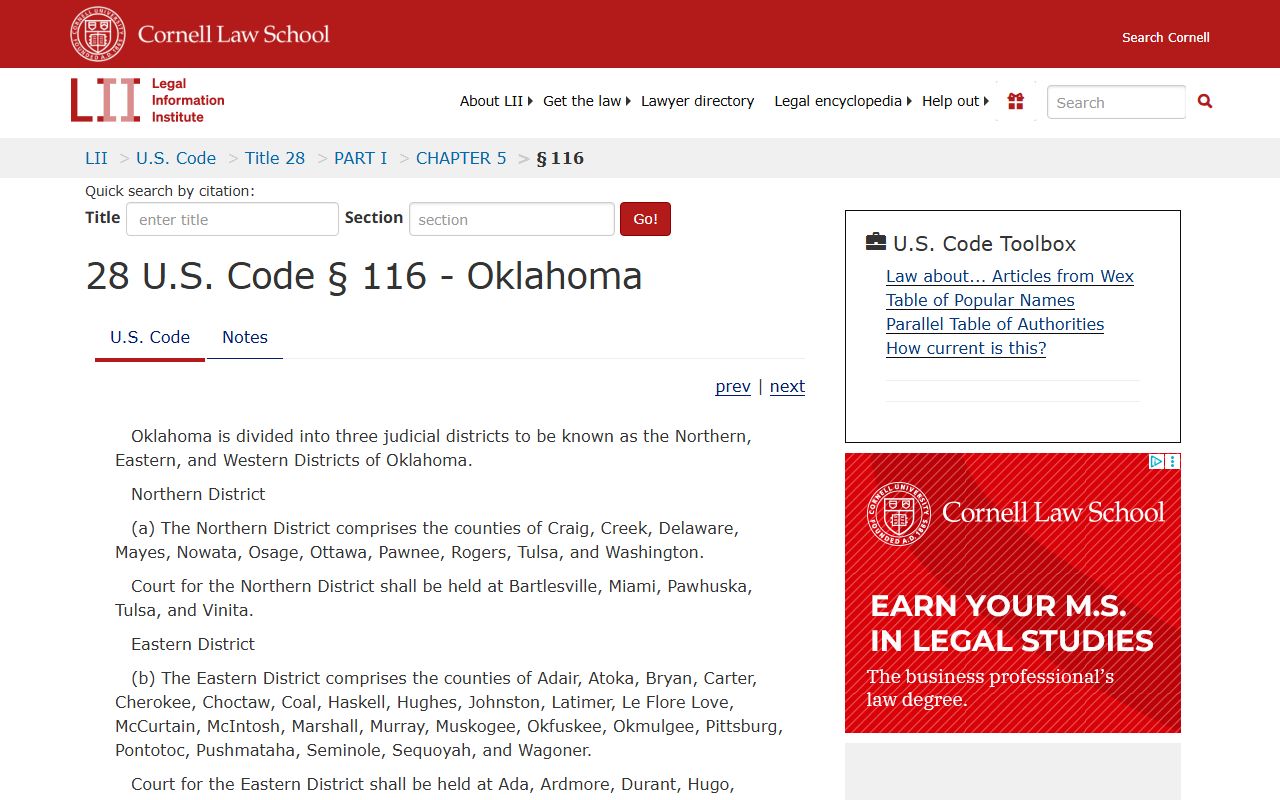
That statute settles the jurisdictional line on paper. It confirms that probate, a state matter, belongs to the Sequoyah County District Court, while the federal courthouse handles a wholly different set of cases.